
If you’ve visited the Insect Control section of our website, then you’ve seen some examples of the pest problems we treat. One that we haven’t blogged about yet is a plant sucking pest called Scales.
According to the University of Minnesota Extension, scale insects are rather inconspicuous and generally occur on the leaves, twigs, branches, and trunks of evergreen and deciduous plants. There are two varieties: soft scales and armored (hard) scales. Soft scales usually secrete an attached waxy layer over themselves that can’t be separated from their bodies and are most often found between branches and leaves of trees. Armored scales have a hard, shell-like cover that is unattached to their bodies and usually don’t migrate to leaves.
Scale insects remove plant fluids from their hosts, which can cause damage to the leaves and needles of the tree, as well as twig and branch dieback, according to the University of Minnesota Extension. Trees can die as a result of a scale problem, but it depends greatly on the size of the tree’s population. Scales can also make plants susceptible to damage from other pests.
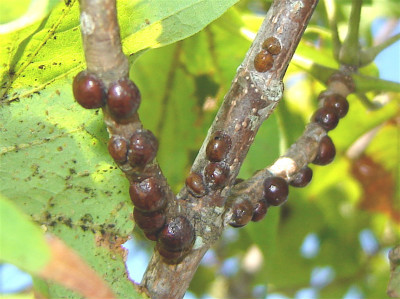
It’s best to attempt control of scales when they are in their most vulnerable stage, which is usually when they first begin searching for feeding sites, but before they produce their protective covers. The time of year for this stage of life depends greatly on what kind of scale species is present.
If you think you have a scale infestation in any of your trees, you shouldn’t hesitate to get a proper diagnosis, and the experts at Cartwright Tree Care would be more than willing to assist you in accurately identifying your particular tree issue. Contact us at 816-965-6758 for all of your tree care needs!
Image via North Carolina Cooperative Extension Service, Johnston County Center