
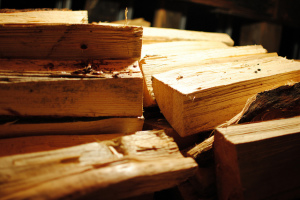
In the past we have discussed how devastating the Emerald Ash Borer beetle is to our area's ash trees. Recently Joe Skinner, with the Missouri Department of Conservation, has determined people are quickly becoming the number one reason the "Green Menace" continues to spread. The experts are now asking that homeowners no longer move firewood in an effort to contain the spread of this insidious disease.
 Source: Flickr
While the beetle is native to Asia, over the last several years it has been found in 21 states and Canada. The International Society of Arboriculture recently put out a statement that this destructive beetle has already begun to damage our ecosystem. It is also lowering homeowner's property values in some areas due to tree loss.
Skinner feels strongly that, while these beetles have already been detected in and around the Kansas City area, more serious devastation could be in the future. Because of this, the Missouri Department of Natural Resources is restricting the transport of ash trees in our area.
If ash trees are on your property and you're concerned about their health please contact Cartwright Tree Care today. For the best in Kansas City area tree care, Cartwright is here to help!